
From Prison Cells To Power: The Untold Story Of Nepal's Greatest Jailbreak
The men who crawled through a 50-foot tunnel beneath Nakhu Jail were not ordinary prisoners but young revolutionaries determined to continue their political struggle. Decades later, some of them would hold the highest offices in Nepal, turning a prison escape into a remarkable chapter of national history.
· 15 min read
A Tunnel Beneath a Monarchy
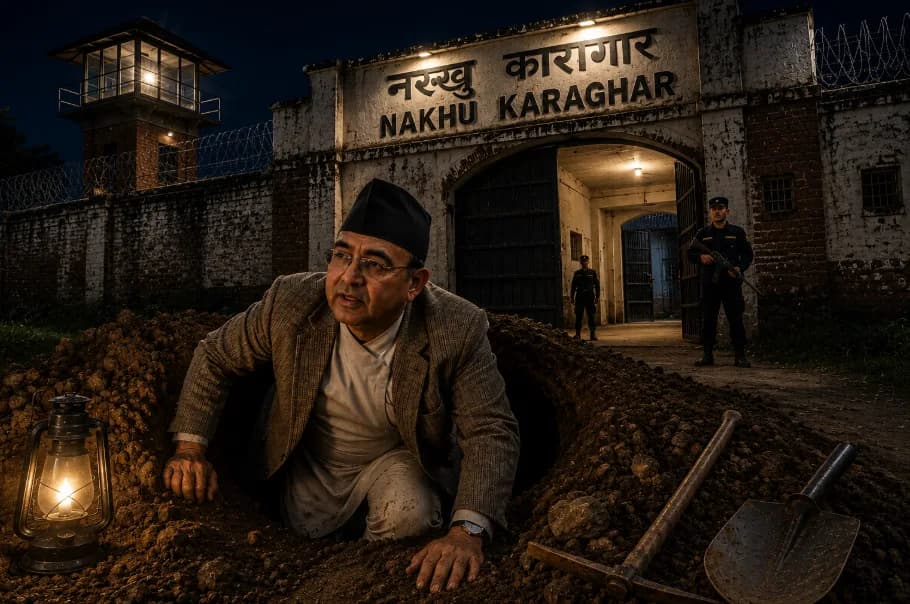
In 1976, beneath the dirt floor of Nakhu Jail in Lalitpur, sixteen men did something that no prisoner had ever done before in Nepal's history. Armed with makeshift tools and driven by revolutionary conviction, they dug a tunnel 50 ft long right under the noses of the Panchayat regime's guards and vanished into the night. The man who led this escape, Chandraprakash (CP) Mainali, would go on to become Deputy Prime Minister of Nepal. The jail they escaped from would become famous not only for this breakout but for the caliber of political prisoners it once held including a young man named KP Sharma Oli, who would one day become Prime Minister.
This is the story of Nepal's most audacious, most organized, and most politically consequential jailbreak: why it happened, how it was done, and what it changed forever.

What Is Nakhu Jail?
Before understanding the jailbreak, it is important to understand the prison itself because its structure is precisely what made the escape both difficult and legendary.
Nakhu Jail, officially known as Nakkhu Karagar (नख्खु कारागार), formerly located at Ward No. 8 of Lalitpur District, in the southern part of the Kathmandu Valley. It was established in 1950 (2007 Bikram Sambat) in what was formerly the Taksar Department the area where the government printed money. The prison covers an area of 35 ropani and 12 ana, approximately 1.8 hectares.
Geographically, the jail is surrounded on all sides. To the east runs a road. To the west lies a school. To the north is a residential area. And to the south flows the Nakhu River, after which the prison takes its name. The facility has two separate blocks: one for male prisoners and one for female prisoners each with a capacity of 250 inmates, giving the jail a total designed capacity of 500 prisoners.
This geography matters enormously for understanding the jailbreak. With a road, a school, a residential area, and a river forming a tight perimeter around the prison, escape through conventional means over walls or through gates was nearly impossible. The decision to go underground, beneath all of it, was not just daring; it was the only logical option.
The World That Made the Jailbreak Necessary
To understand why CP Mainali and fifteen others were willing to spend weeks digging in the dark, you must first understand the political world that put them there.
The Ideological Roots: From Naxalbari to Jhapa
The story begins not in Nepal but across the border in India. In 1967, a violent peasant uprising broke out in Naxalbari, a small area in the Darjeeling district of West Bengal. Inspired by Mao Zedong's theory of armed peasant revolution and the Chinese Cultural Revolution of 1966, communist activists began what became known as the Naxalite movement a campaign of armed struggle targeting landlords and the state.
The Naxalite movement did not stay in India. After the Indian government launched a massive crackdown in 1967, senior Naxalite leaders including Kanu Sanyal and Jangal Santhal crossed the border into Jhapa district of eastern Nepal which directly adjoins the Naxalbari tract of the Siliguri subdivision. According to Senapati and Rana, "these fugitive extremists were often given shelter at Jhapa by the Nepalese Maoist leader, Gopal Prasai." The ideology and the men who carried it had arrived in Nepal.
The Land Question in Jhapa
Nepal's eastern Jhapa district was fertile ground literally and politically for revolution. In 1964, King Mahendra had announced land reforms, setting a ceiling on how much land one person could own and establishing tenant rights over land use that King Mahendra had even visited Jhapa personally to announce the reforms and distribute land ownership certificates to some tenants.
But as Dewan Rai reported in the Kathmandu Post (2018) , "the landowners did not honour the documents, which enraged the farmer-tenants." The Communist Party of Nepal channelised this farmer disappointment into a political uprising the Jhapa Revolt.
The revolt's goal was not merely land rights. It aimed to seize rice and distribute it to farmers, establish tenant rights, and ultimately dismantle what the communists called the "bourgeois feudal" foundations of Nepali society. Its method was brutal: the targeted killing of landlords, described as "class enemies."
The Jhapa Rebellion: Who Were These Men?
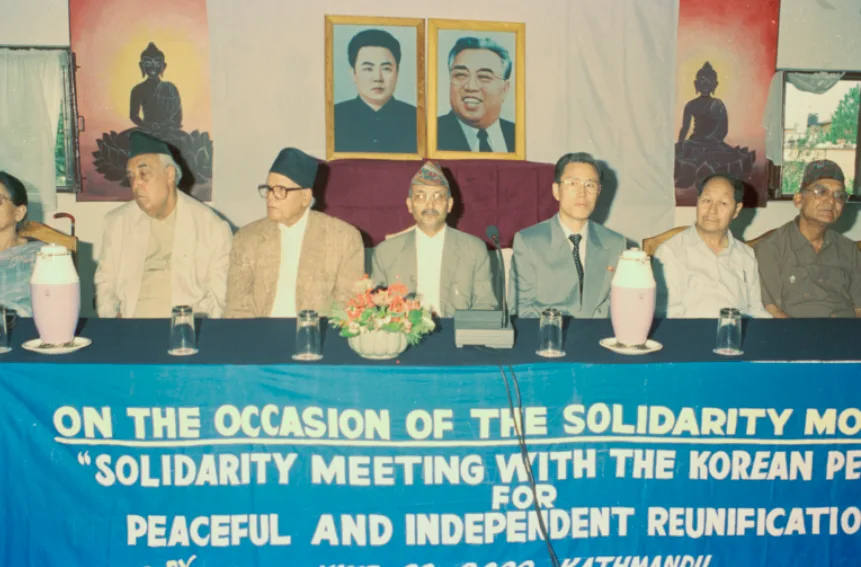
Source: Oli (Center) With Other Political Leaders And North Korean Delegate, Record Nepal, Record Nepal, 24 July 2020
The Jhapa Rebellion was led by the district committee of the Communist Party of Nepal, operating under the Koshi Provincial Committee. The key members, as documented in The Record (2018), were:
CP Mainali (Chandraprakash Mainali) the younger of the two Mainali brothers and the man who would lead the jailbreak. Mani Dahal, writing in Nepal News (2025), describes CP as a brilliant student who "ranked fifth in the 1967 SLC exams" nationally. He entered Amrit Science College and even passed a scholarship examination to study abroad but was denied the scholarship due to poor eyesight. This frustration deepened his involvement in revolutionary politics. By 1972, CP had been elected party secretary, becoming the dominant figure in the Jhapa movement.
RK Mainali (Radha Krishna Mainali) CP's elder brother, who came from a landlord family himself. In what the Republica (2010) describes as an act of idealism, he and his younger brother literally tore up tamasuks: debt deeds that poor farmers owed to their landlord forefathers to liberate poor tillers from debt bondage. RK was also an advocate of armed struggle.
KP Sharma Oli the future Prime Minister of Nepal was then a young member of the Ilaka Committee in Charpane. Crucially, Oli was actually on the opposite side of the armed struggle debate within the party. Oli argued that killing individuals would invite unnecessary repression and hamper party growth. He was overruled by the majority who supported armed struggle. CP Mainali later removed Oli from his position as party secretary, as Oli himself confirmed in a 2003 interview: "CP Mainali supported the Naxalites. I was against it. He became strong, did a campaign, and removed me as secretary."
Naresh Kharel another armed struggle advocate who would later participate in the jailbreak.
Ramnath Dahal, Oli's political mentor and one of the most intellectually influential figures of the rebellion. In his 2003 interview, Oli recalled: "He knew all of history, including about Spartacus and Rome. I was very impressed by his knowledge."
Mohan Chandra Adhikari another key figure who would later become Prime Minister of Nepal.
The Rebellion Is Crushed: Arrest, Murder, and Imprisonment
The Panchayat regime responded swiftly and brutally. Police launched search operations across the east, rounding up rebels. As Rai documents in The Record(2018) , "five were arrested and later killed in a fake encounter in Sukhani forest bordering Jhapa and Ilam on March 4, 1973."
The Sukhani Kanda: Nepal's Most Notorious Fake Encounter
This event known as the Sukhani Kanda is one of the darkest chapters in modern Nepali history. The five men killed were Ramnath Dahal, Netra Ghimire, Viren Rajbanshi, Krishna Kuinkel, and Narayan Shrestha. As documented in Notes Nepal, they were taken to Sukhani forest and killed by the then Panchayat rulers on the charge of forming a front against the Panchayat system taken under the false pretext of a jail transfer from Chandragadhi Jail in Jhapa to Ilam Jail. Ramnath Dahal the mentor who had taught a young KP Oli about Marx, Mao, Montesquieu, and Spartacus was among those murdered.
KP Oli confirmed in his 2003 interview that Dahal and four others were taken to the side of the road and were killed while transferring to Ilam Jail. He was arrested himself in October 1973 in Rautahat and would remain imprisoned until 1987.
Where Was KP Oli? Why Didn't He Escape?
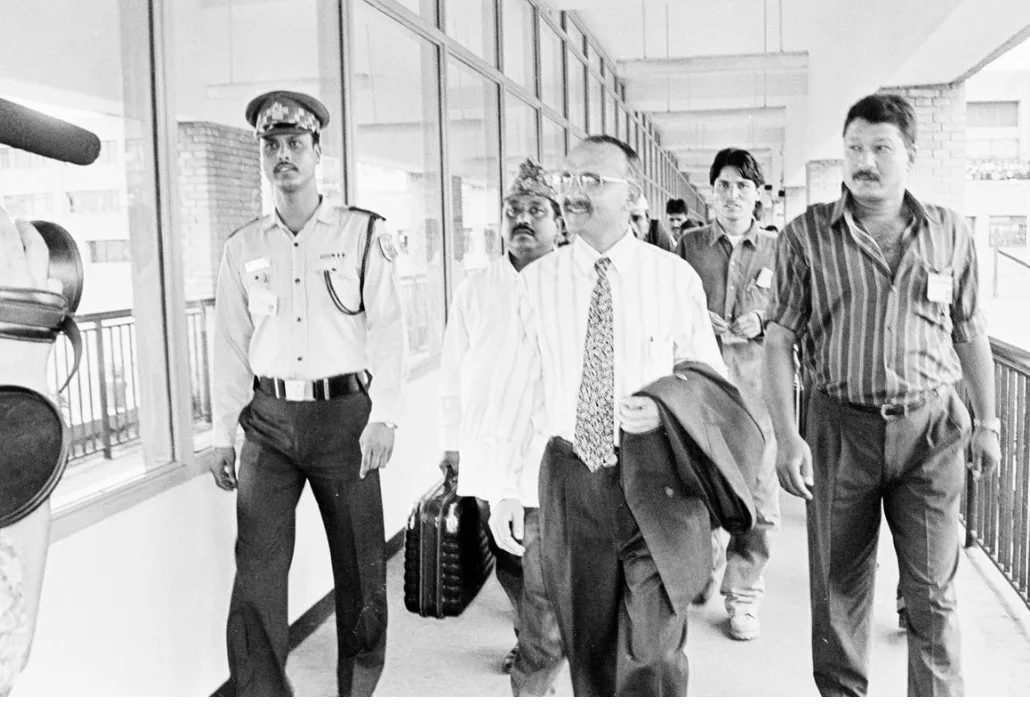
Source: Oli And The Jhapa Rebellion, Record Nepal, Record Nepal, 24 July 2020
A natural question arises: if KP Oli was in the same prison system, why didn't he escape too?
The answer is both practical and philosophical. Oli was transferred so frequently through Gaur, Birgunj, Bhadragol, Central Jail, Nakhu, Pokhara, Syangja, and Hanuman Dhoka that establishing the months-long coordination required for a tunnel escape was nearly impossible. He spent four years in solitary confinement in Central Jail's Golghar, with only cold water and no contact with other prisoners.
Most revealingly, Oli himself chose not to escape even when he had the opportunity. In 1984, while briefly outside jail in hospital, his own secretary urged him to flee. Oli refused. His reason as he told researchers in 2003, was principled: "Why should I run away? It is very hard to conduct a movement while in hiding. You have to behave like a criminal."
This is perhaps the most telling contrast in the entire story. Oli and CP Mainali chose opposite paths from the same jail one stayed and built his reputation through legitimate suffering; the other escaped and built his reputation through daring action.
Oli also confirmed directly that he was in Nakhu Jail at the same time as CP Mainali, but had been transferred to Central Jail before the escape took place: "Yes, I was in that same cell that CP Mainali escaped from. But by the time he did that, I was in Central Jail." This single statement from the man who became Prime Minister is the most powerful direct confirmation of the jailbreak in any published source.
The Jailbreak: 50 Feet, 45 Days, and 16 Men
By 1975 and 1976, CP Mainali and fellow Jhapa rebels had been moved through various jails and eventually concentrated at Nakhu. In January 1976, the government formally charged CP and others with murder and abduction as Mani Dahal reports in Nepal News (2025). They were facing serious convictions under a regime that had already shown its willingness to kill political prisoners in fake encounters.
The decision to escape was a decision of survival as much as ideology.
The plan was audacious in its simplicity and staggering in its execution. Working in secret, using makeshift digging tools, the prisoners began excavating a tunnel from inside their cell. The tunnel would need to travel fifty feet underground beneath the jail walls, beneath the perimeter to emerge outside the prison boundary. It took approximately 45 days of digging, conducted carefully to avoid detection by guards.
The key to understanding why this was so difficult lies in Nakhu Jail's structure: a tight 1.8-hectare compound surrounded by walls, with a road, school, residential area, and river on all four sides. Every direction presented obstacles. The tunnel had to be deep enough to avoid collapse and long enough to clear the perimeter entirely.
In 1976, CP Mainali and 15 other prisoners broke out of Nakhu Jail. As Nepal News (2025) reports, the escape "enhanced his fame" enormously within the underground communist movement, it became legendary. Of the 16 who escaped, however, five were subsequently rearrested, as documented by Notes Nepal. Among those who successfully remained free was CP Mainali himself, along with Naresh Kharel.
The escape was not a sudden decision but a carefully planned operation that took nearly 45 days. CP Mainali and his fellow prisoners secretly dug a 50-foot tunnel at night from inside their cell. To avoid suspicion, they raised rabbits near the entrance of the tunnel and covered the opening beneath the rabbit enclosure. Guards rarely checked the area because of the rabbit droppings. Whenever prison officers approached unexpectedly, prisoners would sing a specific song to alert those working underground. If someone was still inside the tunnel, others would quickly create a dummy figure in the cell so it looked like everyone was present. One of their biggest challenges was disposing of the soil from the tunnel. They quietly mixed it into garden areas, scattered it while washing dishes, and hid it in different parts of the prison compound. Inside the tunnel, they first used candles for light, but the flames consumed oxygen and made breathing difficult. They later managed to use an electric bulb for safer lighting. It was possible because the prisoners' work inside the jail had been divided along different trades: some worked in the kitchen, some in the garden, and one happened to be assigned to electrical work. It was this stroke of luck having a man with access to wiring and bulbs that let them light the tunnel safely. On the night of the escape, they even sabotaged the prison's main electricity supply, plunging the area into darkness. Knowing that they could face death or spend many more years behind bars, the prisoners decided to take the risk. Their cell happened to be close to the outer boundary, so the 50-foot tunnel led directly outside the prison walls. Under the cover of darkness, all 16 men crawled through the tunnel and disappeared into the night. Remarkably, prison authorities did not discover the escape until the following morning, making it one of the most daring and successful jailbreaks in Nepal's history. Source credit: Misguided Nepal NEPALI Ministers PRISON BREAK by digging 50ft TUNNEL
The Two Brothers: Two Different Choices
The contrast between CP and RK Mainali in the aftermath of the jailbreak is striking and documented by the Republica (2010): "The younger Mainali broke the jail in 1976 and ran away while the elder one served 13 years of prison sentence before being released in 1986."
RK Mainali, the elder brother who had co-founded the rebellion, chose to stay and face his sentence. CP Mainali, the younger brother and party secretary, chose to tunnel out and continue the revolutionary work from underground.
After the Escape: How the Jailbreak Shaped Nepal
The jailbreak was not just a dramatic story; it had profound political consequences that reshaped Nepal.
After escaping, CP Mainali went underground and in June 1975 had already founded the "All Nepal Revolutionary Coordination Center (Core) Marxist-Leninist" known as Core. As Nepal News (2025) documents, “Over the years, Core united various small communist groups into the CPN (ML), the Communist Party of Nepal (Marxist-Leninist), formally founded on December 26, 1978, with CP Mainali elected as General Secretary.”
CPN (ML) was the direct predecessor of CPN (UML) today, one of Nepal's two largest political parties and the party that produced two Prime Ministers. The party that was built by a man who tunneled out of Nakhu Jail is the same party that has governed Nepal for much of the democratic era.
CP Mainali himself went on to serve as Deputy Prime Minister and Minister for Women, Children, and Social Welfare under KP Sharma Oli's government; two men, once in the same cell, who took opposite paths out of the same prison system, and both ended up in government together.
The Irony: Heroes and Criminals
The Nakhu jailbreak raises a profound and uncomfortable question that echoes through Nepal's politics even today.
Former Prime Minister Baburam Bhattarai captured this irony sharply in a 2020 tweet reported by Setopati: "Ironically, Tharu rebellion has been deemed crime under the regime of the heroes of Jhapa rebellion and People's War. This injustice is intolerable." As Setopati noted, "PM KP Sharma Oli was part of the Jhapa rebellion wherein multiple persons were hacked to death five decades ago. He was jailed on murder charge for participating in the rebellion during the Panchayat regime."
The men who killed landlords, broke out of jail, and went underground are today celebrated as founding fathers of the Nepali left . The families of those killed during the rebellion, however, have never received justice. As Yubaraj Bimali, whose father was murdered by Jhapa rebels in 1972, told the Kathmandu Post: "They killed people and became ministers without ever having been tried, which has set a wrong political culture."
Even CPN-UML members, the Kathmandu Post reported, "shyly admit that Jhapa rebellion was an ugra-bampanthi bhadkau" — an ultra-left deviation.
The Final Twist: The Revolutionary Turns Royalist
If the jailbreak is the dramatic centre of CP Mainali's story, its most ironic epilogue may be this: the man who tunneled out of a monarchist prison, who devoted decades to building Nepal's communist left, who voted for the republic in the 2015 constitution at the age of 73, and began publicly advocating for the return of the monarchy.
As Mani Dahal reported in Nepal News (2025), CP Mainali has said: "A head of state is needed who will uphold the constitution and protect the nation's sovereignty, independence, and integrity. Should this head of state be a traditional king or not?" He now displays portraits of both communist philosophers and kings at his home in Chabahil, Kathmandu. He regards kings like Prithvi Narayan Shah, Mahendra, and Birendra as equally important as Marx, Engels, Lenin, and Mao.
The man who once tunneled beneath the walls of a monarchist prison now wonders aloud if the king should return.
Why Is the Nakhu Jailbreak the Biggest in Nepal's History?
Several factors make the 1976 Nakhu jailbreak historically unique:
First, it was organized entirely from within a high-security political prison, by men who were being held specifically because the state feared their organizational capacity. Second, it required months of coordinated planning and physical labor conducted in total secrecy under constant guard surveillance. Third, it involved 16 prisoners making it the largest organized individual escape in Nepal's prison history up to that point. Fourth, the escapees were not common criminals but the founding generation of what became Nepal's largest political party. And fifth, its consequences were not just personal freedom for the escapees; they reshaped the entire trajectory of Nepali politics.
The 2025 jailbreak during the Gen Z protests, while involving more prisoners, was a chaotic mass escape during a breakdown of order. The 1976 Nakhu jailbreak was the opposite: methodical, secret, planned, and executed by men who knew exactly why they were doing it and what they intended to do next.
That is what makes it Nepal's greatest jailbreak.
Sources
1. Rai, Dewan. "Oli and the Jhapa Rebellion." The Record, 30 March 2018. https://www.recordnepal.com/oli-and-the-jhapa-rebellion
2. Gellner, David N. and Mrigendra Bahadur Karki. "KP Oli's Early Life and Influences." The Record, 26 August 2018. https://www.recordnepal.com/kp-olis-early-life-and-influences
3. "Tharu Rebellion Deemed Crime in Regime of Jhapa Rebellion and 'People's War' Heroes: Bhattarai." Setopati, 18 December 2020. https://en.setopati.com
5. Dahal, Mani. "Commander of the Jhapa Rebellion in Royalist Cloak." Nepal News, 12 October 2025. https://english.nepalnews.com/s/feature/commander-of-the-jhapa-revolution-in-royalist-cloak/
7. "Sukhani Kanda." Notes Nepal. https://notesnepal.com/archives/6841
Published Jun 23 in Researched Article